Events
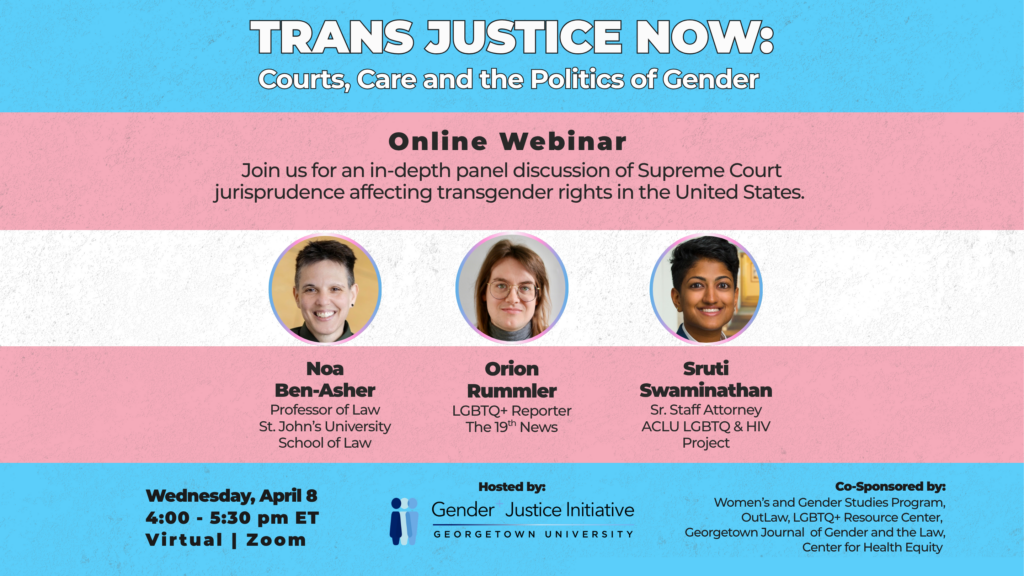
Trans Justice Now: Courts, Care and the Politics of Gender | April 8, 2026
Noa Ben-Asher, Orion Rummler, and Sruti Swaminathan join us for a panel discussion on Supreme Court jurisprudence affecting transgender rights in the US today. Please email us for access to this video.
Jennifer Boum Make discusses her newest publication, Decolonial Care: Reimagining Caregiving in the French Caribbean. This book examines how colonial legacies shape caregiving practices in the French Caribbean, drawing on novels, graphic narratives, and curatorial discourse.
Faith, Feminism, and Being Unfinished III: Love Wins features musical performances by artist Michaela Harrison (SFS ’92) and a conversation led by Katie Lacz and Kate McElwee from the Women’s Ordination Conference, exploring the intersection of women’s lived experiences, creativity, and spiritual reflection.
Lina Soualem screened and discussed one of her latest films, Bye Bye Tiberias (2024). An important and beautifully crafted portrayal of Arab women’s lives, filled with complexity and courage.
Alice Diop screened and discussed one of her latest feature films, Saint Omer (2022). A courthouse drama that explores themes of motherhood, cross-cultural understanding, immigrant lives, and more.
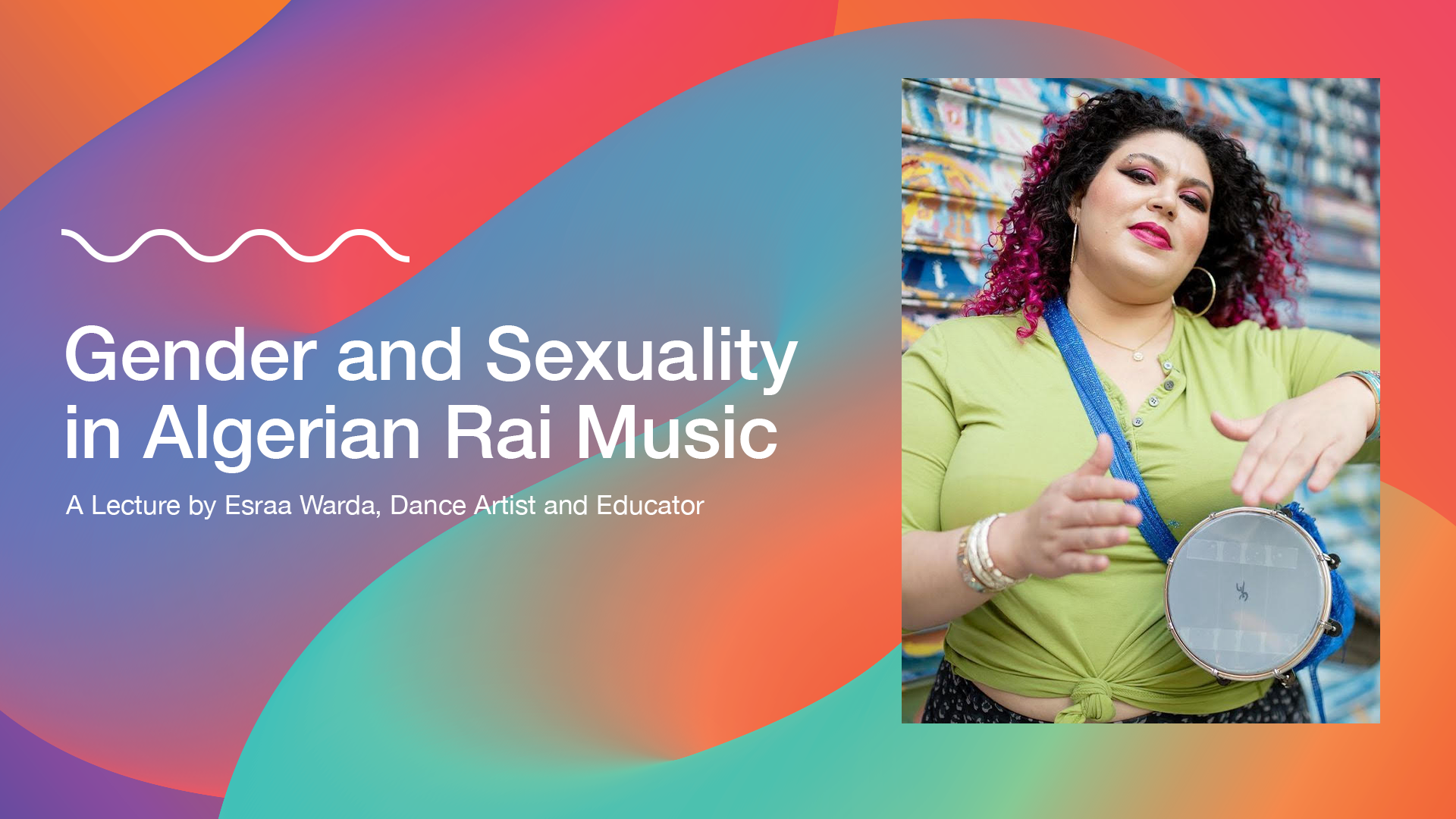
Gender and Sexuality in Algerian Raï Music | November 3, 2022
Esraa Warda presented a lecture entitled ‘Gender and Sexuality in Algerian Rai Music.‘ Known as the “rebel blues”, Raï is one of Algeria’s noteworthy movements of independent artists that have been historically marginalized and stigmatized. Please email us for access to this video.
Rokhaya Diallo screened and discussed one of her latest documentaries, Bootyful (2021). From France to the United States via Brazil, the film reveals the history and body politics behind the global craze for a certain type of voluptuous “derriere.”
Rokhaya Diallo, Maboula Soumahoro, and Jean Beaman discussed racial justice and police violence in France. The discussion centered Black and Brown women leading the fight against systemic racism.
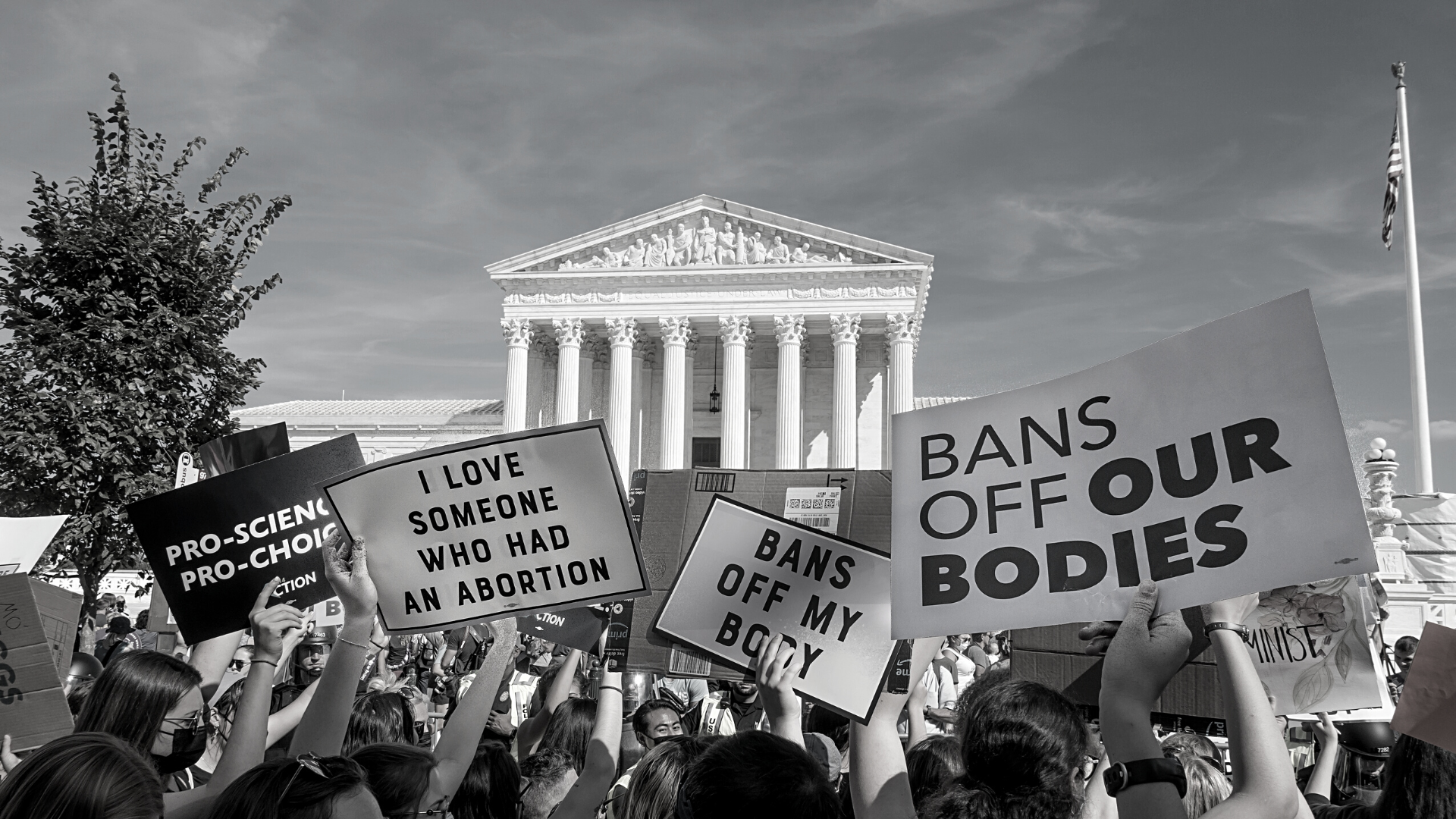
After Dobbs: the Assault on Reproductive Justice and Equality | September 16, 2022
Three multi-disciplinary panels and interactive discussions with leading scholars, activists, practitioners, and elected officials about the Supreme Court’s decision in Dobbs v. Jackson, which overturned Roe v. Wade and decimated the fundamental right to abortion and bodily autonomy.
Amanda Phillips and Soraya Murray discussed Gamer Trouble, which takes readers under the hood of the mechanisms of video games in order to understand the ways that difference gets baked into its technological, ludic, ideological, and social systems.
In this important book, Brown and Casarez Lemi center Black women’s bodies, specifically their hair texture and skin tone, to evaluate how the historical legacies that shape current cultural and political contexts dictate Black women elites’ political experiences and voter evaluations of them.
Dr. Sami Schalk’s interdisciplinary research
focuses broadly on disability, race, and gender in contemporary American literature and culture, especially speculative fiction and Black literature.
In this landmark book, Deborah Tuerkheimer, former prosecutor, legal expert, and leading authority on sexual violence, examines why we are primed to disbelieve allegations of sexual abuse—and how we can transform a culture and a legal system structured to dismiss accusers.
In honor of Black History Month, Reverend Jacqui Lewis discussed her latest book Fierce Love: A Bold Path to Ferocious Courage and Rule-Breaking Kindness that can Heal the World with Rev. William Lamar and Ruby Sales.
Jane Varner Malhotra (G’21) introduces two Georgetown trailblazers in her short documentary More to the Story: Documenting the Lives of the First Known Women Students at Georgetown, Dr. Annie E. Rice and Dr. Jeannette J. Sumner.
Françoise Vergès discussed her latest book, A Decolonial Feminism, which grapples with the central issues in feminist debates today: from Eurocentrism and whiteness, to power, inclusion and exclusion. Delving into feminist and anti-racist histories, Vergès also assesses contemporary activism, movements and struggles, including #MeToo and BLM.
Marlon Peterson, leading advocate for prison abolition and transformative justice, candidly recounts his coming of age in Brooklyn and surviving incarceration. By exposing the many cages that constrain us, he calls for an abolitionist vision as the only way forward.
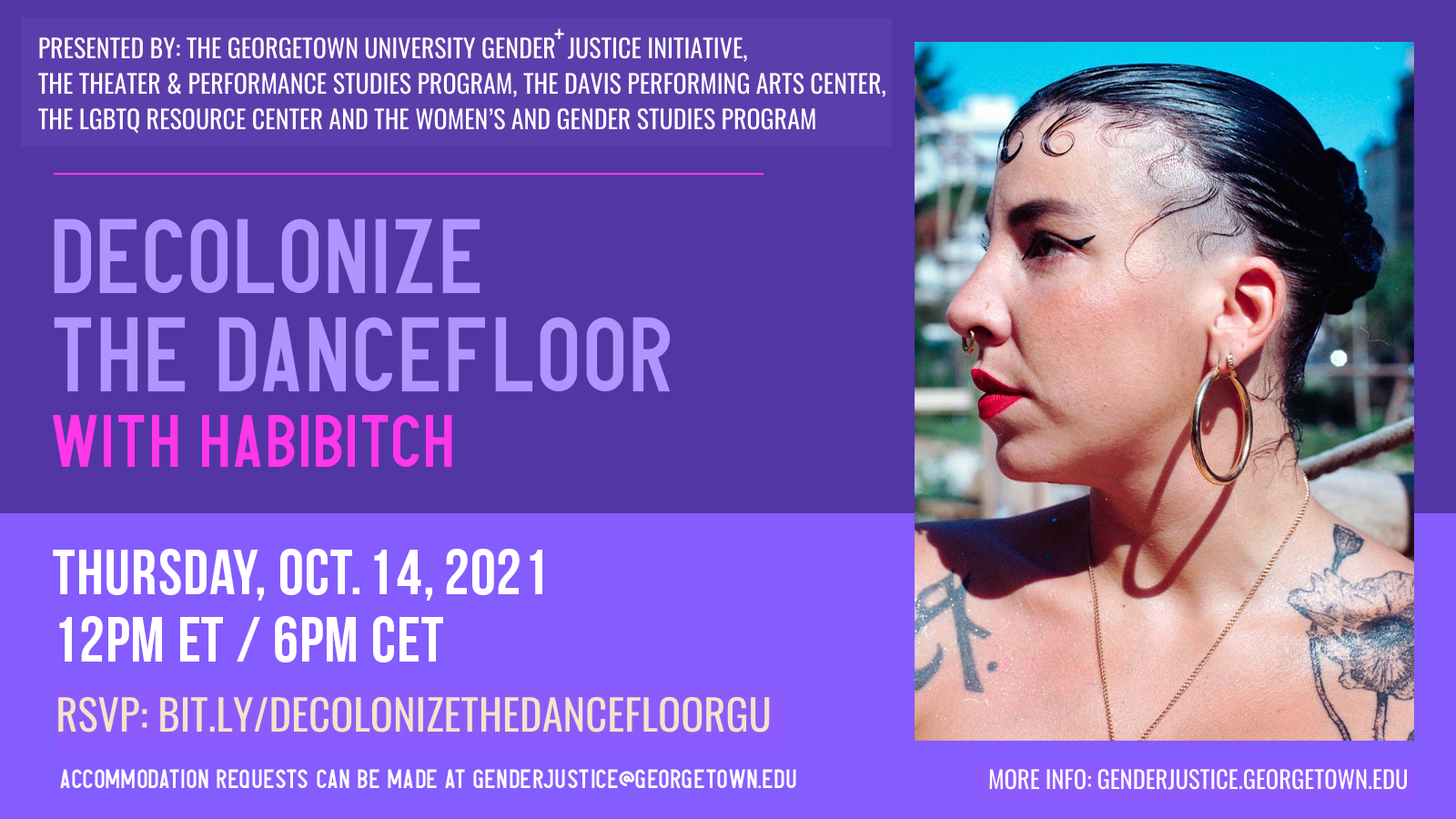
Decolonize the Dancefloor with Habibitch | October 14, 2021
With “Decolonize the Dancefloor”, artist and activist Habibitch explores the systems that shape our daily social relationships. Racism, privilege(s), domination(s), resistance, creation, community(ies), fundamental concepts are dissected under a sharp decolonial magnifying glass. Please email us for access to this video.
With Franchise, Chatelain reveals the complicated role the fast-food industry plays in African-American communities, a portrait of race and capitalism that masterfully illustrates how the fight for civil rights has been intertwined with the fate of Black businesses.
This conversation covers the new Texas’ abortion law, known as Senate Bill 8, its unusual structure, its impact in Texas, the litigation over it, and what it means for the future of abortion rights in the United States.
Sexual Citizens is a groundbreaking study that transforms how we understand and address sexual assault. Through intimate portraits of life and sex among today’s college students, the authors reveal the social ecosystem that makes sexual assault a predictable element of life on a college campus.
This conversation was an opportunity to discuss and learn more about the current processes for reviewing equity in faculty salaries from administrators from each campus.
Lane Windham presented her book Knocking on Labor’s Door: Union Organizing in the 1970s and the Roots of a New Economic Divide (2017). Drawing from Dr. Windham’s book, the discussion explored past and present workers’ organizing.
Thompson Ford discussed his latest book, Dress Codes: How the Laws of Fashion Made History (2021). An insightful book that explores dress codes that still influence social mobility. The conversation centers the intersections of race, gender and class.
This conversation explores: BIPOC mental health issues, related specifically to the COVID-19 pandemic and racism/racial injustice; stigma, barriers, and structural and systemic racism within the healthcare system; strategies, resources and support available during these challenging times.
In light of the 2020 Presidential elections, this conversation explores Black women’s past and current political participation and representation, and envisions possibilities for Black feminist futures.
A screening of Bitter Flower, a play that explores the relationship between two major figures of the suffrage movement, Ida B. Wells-Barnett and Jane Addams. The conversation examines the racism of the white suffrage movement and the undervalued work of Black suffragists.
This panel discussion gives an overview of patterns of gendered violence practices taking place in (ICE) detention centers as well as sheds light on how activists and advocacy groups are fighting to address the issue.
How do we grapple with the issues and implications of the #MeToo movement? Professor Tannen speaks with panelists from the EEOC, the National Women’s Law Center, and Georgetown University to examine the nuances behind #MeToo: its political and cultural predecessors, its effect on low-income workers and women of color, and its relationship to systemic inequality.